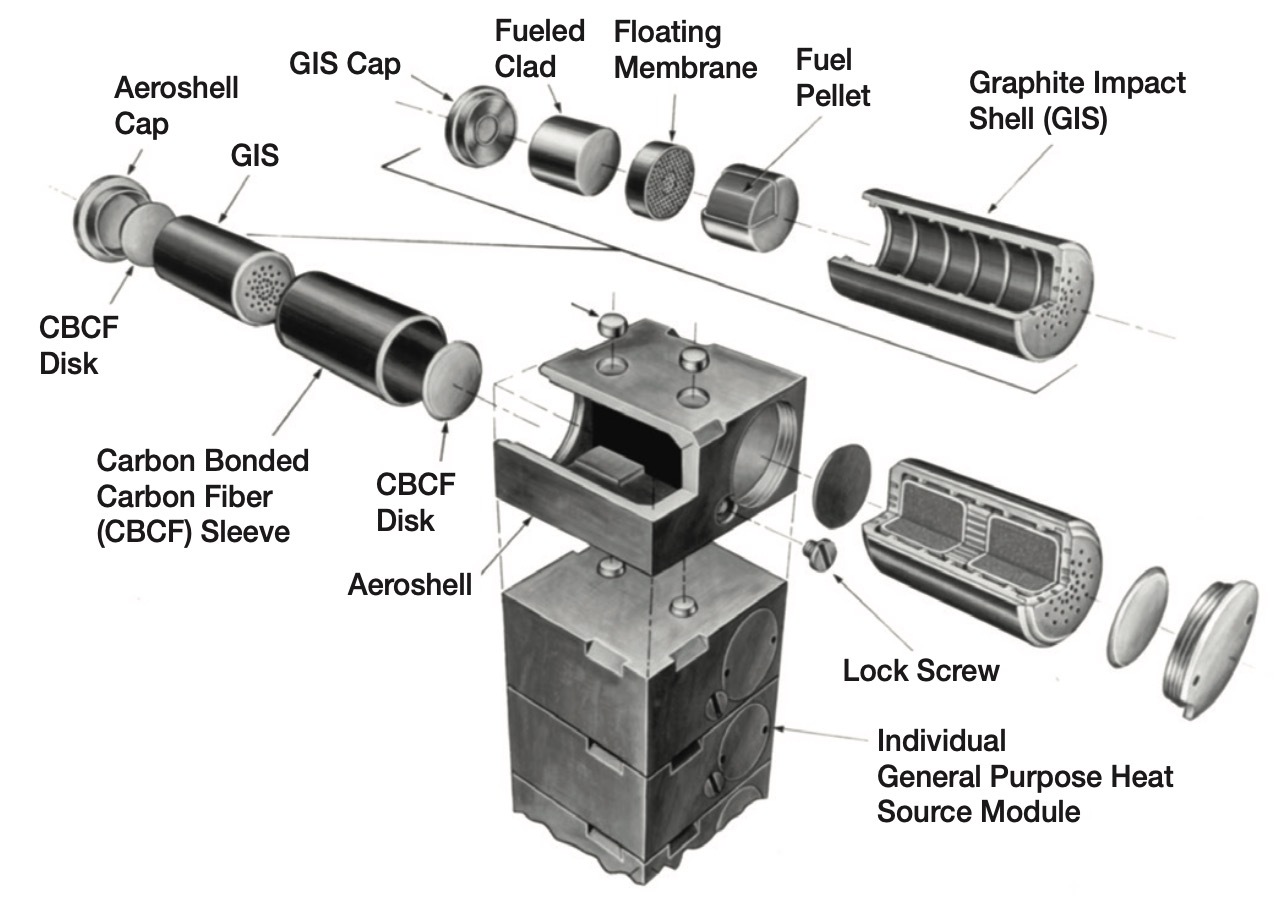
The general-purpose heat source is a U.S. DOE-designed radioactive heat source for radioisotope thermoelectric generators (RTG) or Stirling radioisotope generators (SRG). It is meant for space applications and is packaged as a stackable module.
Characteristics
GPHSs are fueled with plutonium-238 dioxide. Each module has a temperature of over 600 degrees Celsius and delivers 250 watts at the time of manufacture. They measure 9.8 cm wide x 9.4 cm deep x 5.4 cm high and weigh no more than 1.44 kg each.
Safety
GPHSs are designed with safety in mind and employ iridium-clad plutonium-238 dioxide pellets. The generated alpha particles are blocked by the cladding, thus no further radiation shielding is necessary. The pellets are encased within nested layers of carbon-based material and placed within an aeroshell housing to comprise the complete module.
The modules can withstand extreme conditions including a launch-pad explosion or a high-speed reentry. Overheating and impact tests were performed on several sample modules.
Uses
GPHSs of this, or very similar, design were used in the GPHS-RTGs of Cassini-Huygens, New Horizons, Galileo and Ulysses. They are used in the multi-mission radioisotope thermoelectric generator, as used by Mars Science Laboratory (Curiosity rover). They are also used in the advanced Stirling radioisotope generator.
Stages of assembly
References
External links
- NASA Radioisotope Power Systems website – GPHS overview