Brookfield Zoo Chicago, known until 2024 as simply Brookfield Zoo, and also known as the Chicago Zoological Park, is a zoo located in Brookfield, Illinois. Brookfield Zoo is owned by the Forest Preserve District of Cook County and is managed by the Chicago Zoological Society. It is largest zoo in the Chicago metropolitan area and houses approximately 450 species of animals in an area of 216 acres (87 ha).
Brookfield Zoo opened on July 1, 1934, and quickly gained international recognition for using moats and ditches instead of cages. The zoo was also the first in the United States to exhibit giant pandas, one of which (Su Lin) has been taxidermied and put on display in Chicago's Field Museum of Natural History. In 1960 the zoo opened the first fully indoor bottlenose dolphin exhibit in the United States, and in the 1980s the zoo introduced the first fully indoor tropical rainforest simulation exhibit, which was the largest indoor zoo exhibit in the world at that time. It is often listed as one of the best zoos in the United States.
History
20th century
In 1919, Edith Rockefeller McCormick donated land she received from her father as a wedding gift to the Cook County Forest Preserve District for development as a zoological garden. The district added 98 acres (400,000 m2) to that plot and in 1921 the Chicago Zoological Society was established. Construction did not begin until 1926 after a zoo tax was approved. Construction slowed during the onset of the Great Depression, but regained momentum by late 1931. Construction went on at an increased pace and the zoo opened on July 1, 1934. By the end of September 1934, over one million people had visited the zoo; reaching four million by 1936.
The 1950s saw the addition of a veterinary hospital, a children's zoo, and the Roosevelt Fountain, named for U.S. president Theodore Roosevelt. The zoo experienced a decline in the 1960s until a large bond issue from the Forest Preserve District allowed it to expand. The zoo opened the nation's first fully indoor dolphinarium in the 1960s.
In the early 1980s the zoo constructed Tropic World, an indoor simulated tropical rainforest exhibit. Tropic World was designed by French architect Pierre Venoa and was completed in 1984. In 1996, a 3-year-old boy was injured when he fell into an enclosure within Tropic World. The incident gained worldwide attention after Binti Jua, a female western lowland gorilla, tended to the child until zoo staff rescued him.
21st century
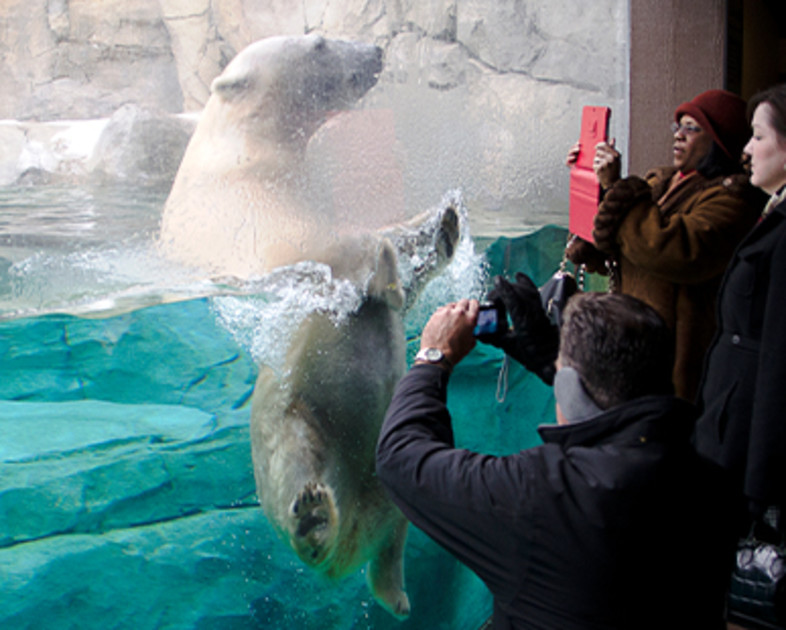
In the early 21st century, the zoo underwent upgrades including construction of the Hamill Family Play Zoo, a large wolf exhibit, an interactive butterfly tent, group catering pavilions, and the largest non-restored, hand-carved, wooden carousel in the United States. Great Bear Wilderness, a $27.3 million exhibit for grizzly and polar bears, opened in 2010. The interiors of several existing buildings were reconfigured into immersion exhibits based upon ecosystems rather than by clades. These included exhibits related to South American coasts, swamps of the Southern United States, and various exhibits related to deserts, the African savanna, and the Australian Outback.
The zoo's reptile house, the first building to open in 1934, closed in 2005 and was converted into the Mary Ann McLean Conservation Leadership Center which does not display live animals, but it details the zoo's larger conservation mission.
In 2011, the zoo faced protests from In Defense of Animals over the deaths of their African elephants, and as a result Brookfield Zoo currently displays elephants or Nile hippopotamus (though the zoo's current master plan has both species expected to return in the coming years). The Children's Zoo, which opened in August 1953, was dismantled in early 2013, and a new family-based series of exhibits known as Wild Encounters opened on the site on July 1, 2015.
The zoo has been closed only five times in its history: On September 14, 2008, after damage from a weekend rainstorm; on February 2, 2011, after a major blizzard; on April 18–19, 2013, after flooding from a severe rainstorm; January 30–31, 2019, due to below-freezing temperatures;, from March 19 to July 1, 2020, due to the COVID-19 pandemic, and on January 12, 2024, due a winter storm.
In September 2023, the zoo received the largest private donation in its history, $40 million, from an anonymous donor.
Notable animals (past and present)
- Ziggy was a 6.5 ton male Asian elephant
- Binti Jua is a female western lowland gorilla who tended to the three-year-old child that fell into her exhibit in 1996
- Cookie, a Major Mitchell's cockatoo, had been part of the zoo's collection since the opening in 1934 until his death in 2016.
Exhibits
- Australia House: Crested pigeons, emerald tree boas, double-wattled cassowaries, emus, princess parrots, Rodrigues flying foxes, short-beaked echidnas, southern hairy-nosed wombats, western grey kangaroos, parma wallabies, prehensile-tailed skinks, Argus monitors, tawny frogmouths, and laughing kookaburras.
- Children's Zoo: Harris hawks, great horned owls, American kestrels, turkey vultures, red-tailed hawks, raccoons, ravens, chickens, goats, groundhogs, Holstein cattle, reindeer, sheep.
- Feather and Scales: Andean condors, blue poison dart frogs, double-striped thick-knees, Gambel's quails, greater roadrunners, green aracaries, boa constrictors, and sungazers.
- Reptiles and Birds (Perching Bird House): African pygmy-falcons, Argus monitors, Bali starlings, bay-headed tanagers, crested wood partridges, green-winged macaws, Micronesian kingfishers, paradise tanagers, tawny frogmouths, and turquoise tanagers.
- Fragile Desert: African crested porcupines, Amur leopards, bat-eared foxes, black-footed cats, caracals, meerkats, rock hyraxes, and sand cats.
- Fragile Hunters: African lions, Amur tigers, sloth bears, and snow leopards.
- Fragile Rainforest: Asian small-clawed otters, bearcats, Burmese pythons, clouded leopard, fishing cats, giant African millipedes, naked mole rats, and northern treeshrews.
- Great Bear Wilderness: American bison, bald eagles, brown bears, and polar bears.
- Habitat Africa! The Forest: Tree pangolin, giant African millipedes, okapis, red-flanked duikers, red river hogs, and Reunion chameleons.
- Habitat Africa! The Savannah: Aardvarks, African wild dogs, common ostriches, klipspringers, reticulated giraffes, and warthogs.
- Hamill Family Play Zoo: African hedgehogs, barred tiger salamanders, mongoose lemurs, ring-tailed lemurs, Blanding's turtles, musk turtles, boa constrictors, and African cichlids.
- Hoofed Animals: Addaxes, Bactrian camels, Grant's zebras, and Grevy's zebras.
- The Living Coast: Humboldt penguins, Inca terns, gray gulls, and moray eels.
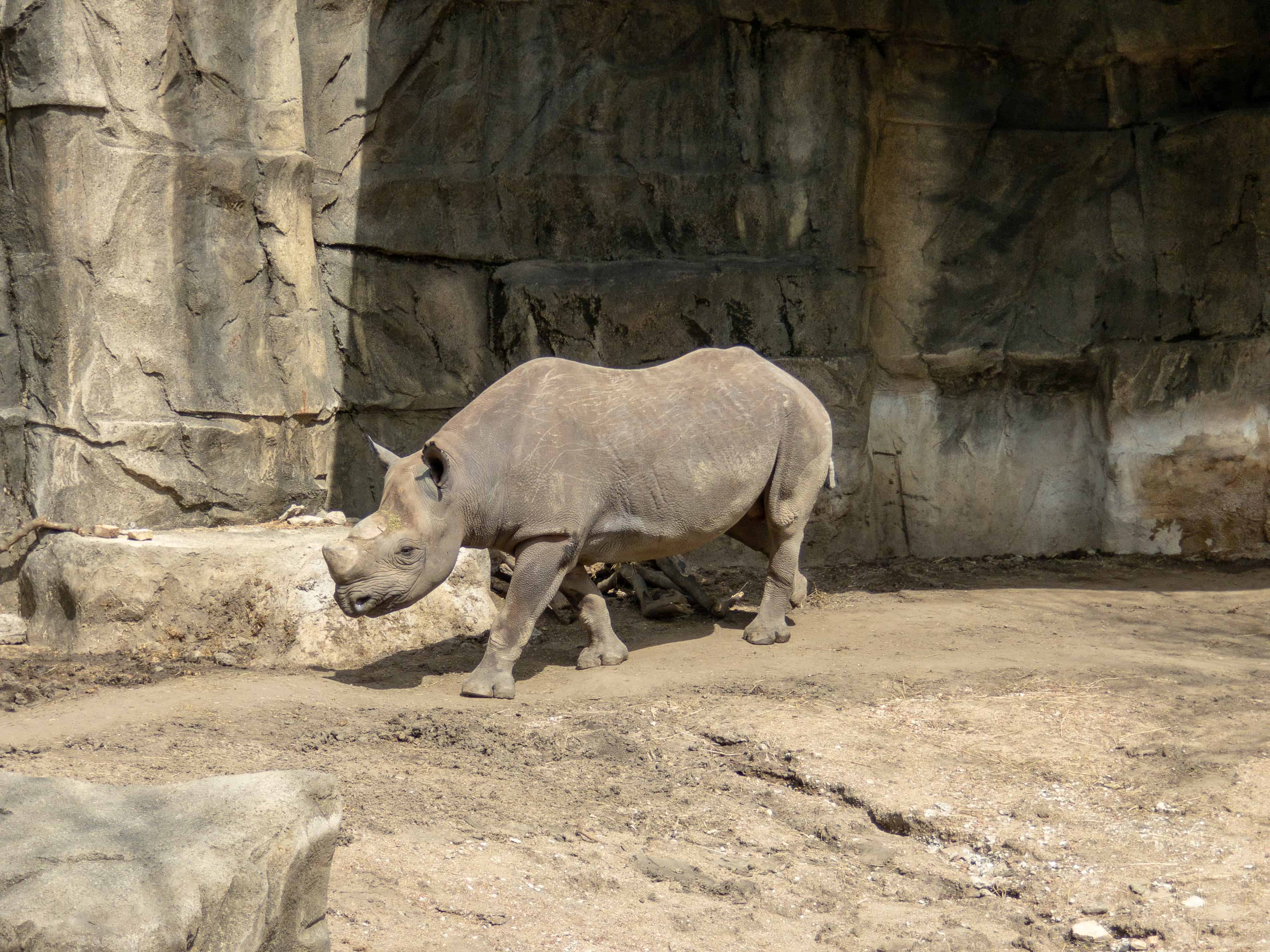
- Pachyderm House: Eastern black rhinoceroses, and South American tapirs.
- Pinniped Point: California sea lions, harbor seals.
- Regenstein Wolf Woods: Mexican wolves.
- Salt Creek Wilderness: Trumpeter swans.
- Seven Seas: Bottlenose dolphins.
- The Swamp: American alligators, alligator snapping turtles, eastern screech owls, little blue herons, North American river otter, and snowy egrets.
- Tropic World: Asian small-clawed otters, Bornean orangutans, collared mangabeys, cottontop tamarins, eastern black-and-white colobuses, giant anteaters, Geoffroy's spider monkeys, golden lion tamarins, mandrills, northern white-cheeked gibbons, sooty mangabeys, and western lowland gorillas.
Notable staff
Chicago cartoonist John T. McCutcheon was the president of the Chicago Zoological Society from 1921 until 1948 and oversaw the zoo's construction, opening and its early years, including helping it through the war years, when the zoo saw a decrease in attendance.
Grace Olive Wiley briefly worked as a reptile curator at the zoo in 1935.
George B. Rabb was the director from 1976 until 2003, having originally worked as a researcher and an assistant to the director.
Conservation programs
Brookfield Zoo Chicago has a conservation project in Punta San Juan, Peru. Disney World partnered with the zoo by giving a $25,000 grant assigned specifically to the work in Punta San Juan, Peru, which helped the Chicago Zoological Society conservationists gain clearance into the highly restricted and protected area. The CZS has hired multiple people that already worked for the reserve to help build a conservation research team. Samples are taken from wildlife such as South American sea lions, Inca terns, Peruvian boobies, guanay cormorants, Grey gulls, and the endangered Humboldt penguins. The team uses the information they gathered to research the environment, observe the species, and monitor populations. Project results further knowledge about the ocean and help save endangered species. Team members also continuously have groups of children, of varying ages, go out to clean up garbage that accumulates on the beaches of Punta San Juan from the Pacific Ocean.
Economics
In 2014, revenue of Brookfield Zoo Chicago was made up by $26.6 million from admissions and guest services, $15.2 million from taxes, $11.5 million from membership dues, $11.5 million from contributions, sponsorships, and net assets released, and $1.2 million from investments and other income. Expenses in 2014 included $15.7 million for admissions and guest services, $15 million for animal collections and conservation programs, $10.7 million for care of buildings and grounds, $7.9 million for management and general, $5.9 million for public education and communications, $3.8 million for marketing and public relations, $3.4 million for fundraising, and $1.4 million for membership. Revenue totaled $66 million and spending totaled $63.8 million during 2014.
In 2010, Governor Pat Quinn granted Brookfield Zoo Chicago $15.6 million to aid repairing and remodeling many parts of the zoo. This included updating the north entrance to the zoo on 31st Street and Golfview Avenue.
The CZS has hosted several fundraising events, Wines in the Wild and Wild Wild Whirl, where they collected various donations ranging in totals from $130,000 to $1.5 million.
A total of 808 volunteers help the zoo with 74,401 community service hours which equates to $1.86 million of work.
Economic movement approaches $150 million, 2,000 jobs, 580 volunteers, and around 2.2 million visitors every year.
Gallery
References
External links
- Official website